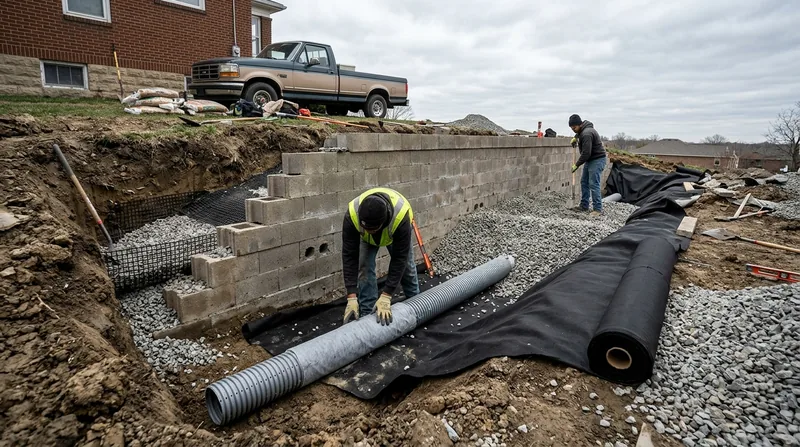




Retaining wall drainage in Toledo is not a luxury add-on. It is the difference between a wall that stands for decades and one that leans, cracks, and fails after a few freeze-thaw cycles. Our city sits on the nearly flat bed of the old Great Black Swamp, cut by the Maumee River, Swan Creek, Ten Mile Creek, and the Ottawa River. Those creek and river banks hold most of the real grade changes, and that is where homeowners run into hydrostatic pressure. Heavy lake-plain clay traps water, a high water table pushes it up, and spring floods load it from behind. We install French drains, weep holes, gravel backfill, and waterproofing that relieve that pressure before it pushes your wall over. If your wall is already showing symptoms, start with a retaining wall repair assessment before the damage spreads.
Toledo's Clay Soil and Freeze-Thaw Winters Make Drainage Non-Negotiable
Most retaining wall failures in Toledo trace back to water, not block strength. The heavy clay across West Toledo, Old Orchard, and South Toledo holds moisture far longer than sandy soils. Add a high water table near the Maumee and Ottawa River corridors, and the soil behind your wall stays saturated for weeks after spring rain. Then hard freeze-thaw winters heave and push. The pressure has to go somewhere, and it usually goes into your wall.
- Hydrostatic pressure builds when water cannot escape and pushes the wall face outward.
- Clay backfill traps water against the wall instead of letting it drain down and away.
- Freeze-thaw heaving cracks mortar joints and shifts segmental block out of alignment.
- Failing weep holes clog with silt and stop relieving water behind the wall.
- Downspout and gutter runoff dumped near the wall top adds load the wall was never designed to carry.
Correcting drainage early costs a fraction of rebuilding a failed wall, and it protects the investment you already have.
Key info: In Point Place, lakefront cottages along Maumee Bay often have poured concrete bank walls with clogged weep holes. After a wet spring, water finds the path of least resistance and pushes the wall face out toward the water. Clearing and rebuilding the drainage behind those walls is usually the fastest fix.
For a broader look at how drainage fits into wall performance, the FEMA flood mitigation resources cover how water pressure affects retaining structures in flood-prone areas.
How We Diagnose and Rebuild Drainage Behind Toledo Walls
We start by reading the site, not by selling a product. We look at the wall type, the soil, the grade above and below, and where water actually goes during a heavy rain. In Sylvania and Perrysburg, where 1960s to 2000s colonials and split-levels sit on sloped lots, the drainage plan often needs to move water around the wall entirely. In the Old West End, Victorian and Queen Anne lots are broad and flat, so the issue is usually clay soil holding water against a bank wall.
- We inspect the wall face, joints, and cap for signs of movement and water staining.
- We probe the backfill to identify clay, silt, and any failed gravel or filter fabric.
- We map the water source, including roof runoff, gutter discharge, and uphill surface flow.
- We design the drain: French drain at the footing, gravel envelope, filter fabric, and weep holes at the right spacing.
- We waterproof the wall face where the wall type allows it.
- We tie the outlet to a safe discharge point away from the wall and the foundation.
Every drainage job ends with a water test so you can see the system working before we leave.
Key info: A Maumee homeowner had a segmental block wall along a walkout patio that had shifted two inches after a wet spring. The weep holes were clogged and the original backfill was clay. We pulled the top courses, replaced the backfill with washed gravel, added a perforated footing drain, and reset the block. The wall has held through two winters since.
If the wall is already leaning or bulging, the drainage work may need to pair with leaning and collapsed wall repair to reset and stabilize the structure.
Drainage Approaches We Use on Toledo Retaining Walls
Not every wall needs the same drainage system. A poured concrete wall in South Toledo behaves differently from a timber wall in a 1920s bungalow yard. We match the approach to the wall type, the soil, and the grade. The table below shows the main methods we use and where each one fits best.
| Approach | Description | Best for |
|---|---|---|
| French drain at footing | Perforated pipe in a washed gravel trench along the wall base, wrapped in filter fabric. | Walls with saturated clay backfill and no existing outlet. |
| Weep holes and gravel backfill | Open weep holes at the base plus a gravel envelope to let water escape the wall face. | Segmental block and poured concrete walls with clogged or missing weep holes. |
| Surface waterproofing | Membrane or coating applied to the wall face to block water intrusion. | Poured concrete walls where the face is accessible and repairable. |
| Grade and swale correction | Regrading the soil above the wall to direct surface water away from the wall top. | Sloped lots in Sylvania, Perrysburg, and Maumee where runoff loads the wall. |
| Downspout and gutter tie-in | Routing roof water to a safe discharge point away from the wall and foundation. | Walls near the house where roof runoff adds hidden load. |
We combine these methods as needed, because most Toledo walls need more than one fix to stay dry.
Retaining Wall Drainage Cost in Toledo: What to Expect
Drainage work on a residential retaining wall in Toledo typically starts from $2,500 for a focused repair with a French drain, gravel backfill, and weep hole restoration. That figure covers a wall of moderate length with reasonable access. Costs move up with wall length, the amount of failed backfill that has to be removed, and whether the wall needs to be partially disassembled to reach the footing. A wall that has already shifted may need structural repair alongside the drainage, which adds cost but prevents a full rebuild later.
Access matters more than most homeowners expect. A wall behind a tight Sylvania side yard or against a Point Place cottage foundation takes more labor than an open bank wall. Soil type also plays a role: heavy clay backfill has to be hauled out and replaced with washed gravel, and that disposal adds to the job. We recommend getting two or three estimates so you can compare scope, not just price. A low bid that skips the gravel envelope or the outlet is not a bargain.
For a full breakdown of what different drainage and repair scopes cost, see our pricing overview.
Retaining Wall Drainage Near Me: How to Vet a Contractor Near Toledo
Hiring the right contractor matters as much as the drainage design. Ask for proof of licensing and insurance before any work starts, and confirm the coverage is current. Get at least two or three written estimates with a clear scope, and ask each contractor how they plan to handle the outlet and the backfill. Check references from jobs in Toledo and the surrounding suburbs, especially walls similar to yours. If your property is in a historic district like the Old West End, ask about local review requirements before work begins.
Permits can apply when a wall holds back a surcharge such as a driveway or structure, and thresholds vary by jurisdiction. Always confirm with the local building department before work starts. We can point you to the right office and help you understand what the inspection will cover.
To schedule a drainage assessment, contact us for a free estimate and we will walk the wall with you.
Retaining Wall Drainage in Toledo: Pricing Guide
| Service | Price | Details |
|---|---|---|
| Drainage assessment and weep hole restoration | Starting at $2,500 | Includes wall inspection, clogged weep hole clearing, and gravel backfill replacement on a moderate-length wall. |
| French drain installation at wall footing | Starting at $3,200 | Perforated pipe, washed gravel envelope, filter fabric, and safe outlet; price moves with wall length and access. |
| Full drainage rebuild with partial wall reset | Starting at $5,500 | For walls that have shifted; includes disassembly, new backfill, drain, waterproofing, and block reset. |
| Complex or large-scale drainage job | On estimate | Tiered walls, tight access, historic district review, or structural repair combined with drainage needs an on-site look. |
| Travel | Included | In Toledo and surrounding areas, no separate call-out or mileage fee. |
| Estimate | Free | Response within 24h at (419) 574-6333, no obligation to book. |
Indicative pricing, the exact cost depends on square footage, finish, and site access. Free personalized estimate within 24h at (419) 574-6333.


