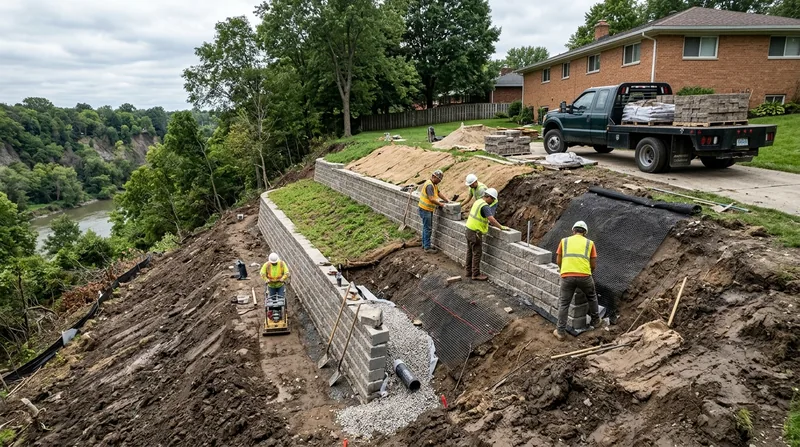




Slope Stabilization & Erosion Control in Toledo: Holding the Grade Where the Swamp Meets the River
Toledo sits on the nearly flat bed of the old Great Black Swamp, and most yards barely move a few inches from the sidewalk to the back fence. The real grade changes live along the Maumee River, Swan Creek, Ten Mile Creek and the Ottawa River, where banks drop six, ten, sometimes fifteen feet into the water. That is where Slope Stabilization & Erosion Control in Toledo earns its keep, because heavy lake-plain clay, a high water table and hard freeze-thaw winters push and heave every bank wall in the city.
We build terraced retaining walls, set geogrid reinforcement and install erosion control on riverbanks, creek banks and cut-and-fill lots from Point Place to South Toledo. We protect the house, the driveway and the yard above the slope, not just the dirt you can see. If you already have a wall that is leaning or bulging, start with leaning & collapsed wall repair before the bank takes the rest of the yard with it.
Why Toledo Slopes Fail: Clay, Creek Banks and Freeze-Thaw
The failure mode that dominates in Toledo is not wind or rain alone. It is saturated clay pushing against a wall that has no drainage behind it, followed by a hard freeze that heaves the face outward and a spring thaw that lets the whole mass slide. Add a high water table and a creek that rises every March, and a bank wall that looked fine in August can be leaning by April.
- Point Place cottages along Maumee Bay lose bank soil every spring as the water table rises and the clay softens.
- Old West End lots with poured concrete and CMU bank walls crack at the footing when freeze-thaw cycles heave the base.
- Sylvania and Perrysburg split-levels on cut-and-fill lots see walkout walls bulge when roof and surface water drains toward the slope.
- South Toledo brick ranches along Swan Creek watch creek-bank soil wash out under fences and patios.
- Waterville and Whitehouse properties on Ten Mile Creek deal with tired railroad tie beds that rot and let the bank slump.
Every one of these failures traces back to water finding a path the wall was never built to handle.
Key info: A 2022 spring thaw in Point Place pushed a 40-foot CMU bank wall out four inches in a single week. The wall had no footing drain and the clay behind it was saturated. That is the typical Toledo failure: water, not age, does the damage.
Most Toledo-area jurisdictions require a permit once a wall passes roughly 4 feet measured from the footing, or when it supports a surcharge such as a driveway or structure. Engineered drawings may be required for tall or tiered walls. Verify the current threshold with the City of Toledo Division of Building Inspection before you dig, and check setback and property-line rules at the same time.
For official permit guidance, the City of Toledo Division of Building Inspection publishes current requirements at toledo.oh.gov.
How We Stabilize a Toledo Slope: Step by Step
We start by reading the water, not the wall. Where does the roof drain, where does the creek rise, and where does the clay hold water after a storm? Once we know that, we can design a bank that sheds water instead of trapping it, and a wall that carries the load without leaning into the yard.
- We walk the slope and mark the grade change, the water table and every downspout, patio edge and fence line that feeds it.
- We open the bank and remove the failed mass, whether that is rotten timber, cracked CMU or slumping clay.
- We cut a proper bench or terrace into the slope so the wall sits on stable soil instead of fill.
- We set a footing drain and gravel behind the wall, then tie geogrid into the retained soil to hold the whole mass.
- We build the wall, backfill in lifts and compact, then seed or armoring the disturbed bank to stop surface erosion.
- We check the finished grade so water runs away from the house, the driveway and the wall face.
The result is a slope that drains and a wall that stays put through the next thaw, not just the next photo.
Local example: On a Sylvania walkout lot off the Ten Mile Creek drainage, we terraced a 12-foot drop into two segmental block walls with geogrid and a French drain at the toe. The homeowner's patio stopped heaving, and the bank above the walkout stayed dry through the spring melt.
Where the bank is steep and space is tight, we often pair the terraces with retaining wall drainage so the water has somewhere to go besides the wall face.
Slope Stabilization Methods We Use in Toledo
Not every bank needs the same fix. A flat Old Orchard lot with a small grade change needs a different approach than a Point Place cottage sitting eight feet above Maumee Bay. We match the method to the soil, the water and the load above the slope.
| Approach | Description | Best for |
|---|---|---|
| Terraced segmental block walls | Two or more stepped walls with geogrid tiebacks and a drain at each toe. | Creek-bank and riverbank lots in Sylvania, Perrysburg and Waterville. |
| Geogrid reinforcement | Grid layers lock the retained soil mass to the stable bank behind it. | Tall or surcharged walls above 4 feet, driveways and structures. |
| Boulder and natural stone toe | Heavy stone at the water line absorbs wave and current energy. | Point Place and Maumee Bay bank edges exposed to spring water. |
| Surface erosion control | Seed, blanket and grading that move runoff away from the slope face. | Cut-and-fill lots in Maumee, Rossford and Oregon with bare clay banks. |
| Timber and tie replacement | Rotten tie beds pulled and rebuilt in block or stone with drainage. | Older South Toledo and West Toledo yards with tired tie walls. |
Each method solves a different part of the same problem: keeping water off the slope and holding the soil that is left.
Slope Stabilization & Erosion Control Cost in Toledo: What to Expect
Every job starts with a free estimate, because no honest number exists until we see the slope, the soil and the water. A small creek-bank repair in South Toledo and a full terraced rebuild in Point Place do not belong in the same price range, and quoting one blind does nobody any favors.
The factors that move the price are the height and length of the bank, how much soil has already slid, access for equipment and material, the wall material you choose, whether geogrid or engineered drawings are required, and how much drainage work the slope needs. Proximity to the house, driveway or a shared property line adds complexity that a flat-lot wall never sees.
Get two or three estimates and compare what is actually included, not just the bottom line. A low bid that skips the footing drain or the geogrid is a wall that will lean again after the next thaw. Our full pricing overview breaks down how we scope each job.
Hiring a Retaining Wall Contractor Near Toledo: What to Check
Slope work is unforgiving. A wall built without drainage or proper compaction can look fine for a season and then fail in the first hard freeze. Before you sign, verify the contractor is fully insured, ask for the certificate, and call two or three recent references on similar banks.
Ask who pulls the permit and who handles the engineering if the wall is tall or tiered. Confirm how the crew will protect the house, the driveway and any mature trees on the slope, and check whether your HOA or a property-line agreement adds rules before work starts. A contractor who answers those questions plainly is one who has done the work before.
Ready to talk through your slope? Reach out through our contact page and we will set up a free on-site estimate.
Slope Stabilization & Erosion Control in Toledo: Pricing Guide
| Service | Price | Details |
|---|---|---|
| Creek-bank or small slope repair | Free estimate | Covers on-site assessment of bank height, soil movement and drainage path; final number depends on access and how much soil has already slid. |
| Terraced segmental block stabilization | Starting at $45 per sq ft of wall face | Includes excavation, footing drain, gravel backfill and geogrid; taller walls above 4 feet and surcharged walls move the number up. |
| Geogrid-reinforced tall wall | Starting at $60 per sq ft | Adds engineered grid layers and compaction testing; required when the wall supports a driveway, structure or tiered load. |
| Boulder and natural stone toe protection | On estimate | Priced by linear foot and stone size; water exposure at the bank edge and equipment access drive the final figure. |
| Travel | Included | In Toledo and surrounding areas, no separate call-out or mileage fee. |
| Estimate | Free | Response within 24h at (419) 574-6333, no obligation to book. |
Indicative pricing, the exact cost depends on square footage, finish, and site access. Free personalized estimate within 24h at (419) 574-6333.


